Manchester scientists find chunky new proton-like particle at CERN
WHO: Professor Chris Parkes, Dr Stefano De Capua, and the LHCb collaboration.
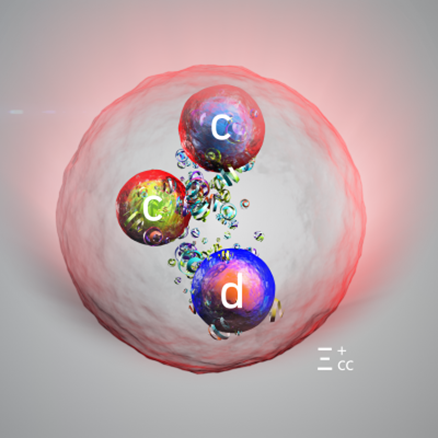
WHAT: Discovery of a new subatomic particle known as Xi-cc-plus (Ξ cc ⁺).
WHERE: CERN’s Large Hadron Collider (LHC) in Switzerland.
WHEN: 17 March 2026.
WHY: To solve a 20-year physics mystery and better understand the fundamental building blocks of the universe.
The discovery of new heavy proton-like particle at CERN has been led by brilliant University of Manchester scientists.
Everything you see around you—from your morning coffee to the train you are sitting on—is made of atoms. At the heart of those atoms are protons, first discovered in Manchester over 100 years ago.
Now, Manchester experts have gone one better by finding a chunky "heavy relative" of the proton. This brand new subatomic particle could change how we understand the very fabric of the universe.
The universe's super-speed camera
The team found the particle using the upgraded LHCb detector at CERN. This piece of kit acts like a giant camera, but it is much faster than your smartphone.
It takes 40 million photographs every single second to catch particles as they zoom past. The silicon "eyes" of this camera were actually built right here in Manchester’s Schuster Building.
Dr Stefano De Capua, who led the production of the sensors, said: "The detector is a form of ‘camera’ that images the particles produced at the LHC. It utilises a custom designed silicon chip."
A peak of 915 events
Scientists spotted the new particle, named Xi-cc-plus, by looking for a specific signal in the data. They found a clear peak of around 915 events at a mass of 3619.97 MeV/c².
This result finally settles a massive scientific argument that has lasted for more than two decades. Earlier claims of finding this particle were unconfirmed, but this new data proves it is the real deal.
Building on a 100-year legacy
Manchester has a long history of smashing atoms to see what is inside. Ernest Rutherford famously discovered the original proton in a Manchester basement back in 1917.
While a normal proton has "up" and "down" quarks, this new version swaps things for "charm" quarks. It is a heavier, more exotic version of the building blocks that make up our world.
Professor Chris Parkes, head of Physics and Astronomy at Manchester, said: "Rutherford’s gold-foil experiment transformed our understanding of matter, and today’s discovery builds on that legacy. This discovery showcases the extraordinary capability of the upgraded LHCb detector."
The UK made the largest national contribution to this upgrade, putting our scientists at the very front of global physics. The team is now looking ahead to the next phase of the LHC programme to find even more hidden secrets of the universe.
Related Links:
MORE: Scientists find 'rotten egg' planet with a 1,000km deep ocean of lava — https://trendwiremedia.com/2026/03/16/scientists-find-rotten-egg-planet-with-a-1000km-deep-ocean-of-lava/
MORE: Scientists find secret engine behind universe’s biggest bangs that wobbles like a top — https://trendwiremedia.com/2026/03/12/scientists-find-secret-engine-behind-universes-biggest-bangs-that-wobbles-like-a-top/
MORE: Scientists find 'rotten egg' planet with a 1,000km deep ocean of lava - https://trendwiremedia.com/2026/03/16/scientists-find-rotten-egg-planet-with-a-1000km-deep-ocean-of-lava/
OFFICIAL SOURCE VERIFICATION: This report is based on official data from University Newsroom. Document: University of Manchester scientists play key role in discovery of new heavy-proton particle at CERN Source Link: https://www.manchester.ac.uk/about/news/university-of-manchester-scientists-play-key-role-in-discovery-of-new-heavy-proton-particle-at-cern/
Author




Subscribe for $2 every four weeks for the first six months
Subscribe for $20 every four weeks for the first six months